Referral infrastructure

Shift left, into the community.

Joy is the referral infrastructure between the care system and live community services, including 295 dedicated work and health programmes. Any care setting can refer in: general practice, hospital teams, community services, or people themselves. Find people, connect them to real support, and see what changed.

1,903,000 referrals and support cases, across systems covering 22.5 million patients.

A link worker and an older woman laughing together over tea in a community centre
JoyInsights

Neighbourhood impact, before and after referral

123,617 patients, measured July 2026

GP contacts-40%

17.5 to 10.5 /patient/yr

A&E attendances-63%

1.61 to 0.60 /patient/yr

Fit notes issued-55%

0.90 to 0.40 /patient/yr

DWP outcomes recorded99.98%

4,039 of 4,040 participant records

Real measured figures; trend shapes illustrative

Trusted by 104 customer organisations, commissioned in 28 of England's 36 integrated care systems


A34 PCN
Barnsley PCN
Bexhill PCN
Blackpool Central West PCN
Blackpool South PCN
Brackley & Towcester PCN
Brent Council logo
Bridlington PCN
Buckinghamshire Place
Burnley West PCN
Cambridgeshire and PeterboroughIntegrated Care Board
Carnforth And Milnthorpe PCN
Coalfields Regeneration Trust logo
Coventry Navigation 1 PCN
Coventry North PCN
Croydon Place
Cumberland Council logo
DevonIntegrated Care Board
Durham East PCN
East Cornwall PCN
East Northants PCN
East Staffordshire
East Surrey Place
Edu-K-Fun logoEnable Leisure and Culture logo
Enfield Care Network PCN
Enfield South West PCN
Everyone Active logo
Falmouth & Penryn PCN
FrimleyIntegrated Care Board
Garstang PCN
GP Connect PCN
Hampton PCN
Handsworth Association of Schools logo
Haringey South West PCN
Haringey Welbourne PCN
Hastings & St Leonards PCN
Hayling Island & Emsworth PCN
Help on Your Doorstep logo
Herefordshire and WorcestershireIntegrated Care Board
High Peak And Buxton PCN
Hyde PCN
Kennet PCN
Kent and MedwayIntegrated Care Board
Kentish Town South PCN
Leatherhead PCN
Leicester, Leicestershire and RutlandIntegrated Care Board
Lewisham Place
Leyland PCN
Lighthouse Community CentreLondon Borough of Barking and Dagenham logoLondon Borough of Havering logoLondon Borough of Tower Hamlets logo
Meir PCN
Mercian PCN
Moorlands & Rural PCN
N2 Islington PCN
Neston & Willaston PCN
New Forest PCN
Newham Place
Norfolk and WaveneyIntegrated Care Board
North & Central Brighton PCN
North Cornwall Coast PCN
North Kerrier East PCN
North Kerrier West PCN
North Solihull (Ordinary Magic) PCN
North West LondonIntegrated Care Board
Nottingham City East PCN
Nuneaton & Bedworth PCN
Oldham Central PCN
One Ellesmere Port PCN
One Wirral CIC logo
Peak Edge PCN
Pendle East PCN
Penwith PCN
Reading Voluntary Action logo
Richmond PCN
Rural Rother PCN
Rural Warwickshire North PCN
Rutland County Council logo
Sheffield Teaching HospitalsNHS Foundation Trust
Shelton & Hanley PCN
Slough Place
South Somerset West PCN
Southampton West PCN
SussexConfederation ADHD Pilot
Sutton PCNs
Thr1ve
Three Harbours & Bosvena PCN
Tone Valley & Taunton Central PCNs
Truro PCN
Wallingford & Surrounds PCN
Walsall East 2 PCN
Waltham Forest Place
Watergate PCN
West And Central PCN
West Berkshire Rural PCN
West Suffolk Place
Western Dales PCN
Whitfield PCN
Wokingham Borough Council logo
Wolverhampton Place

Joy is commissioned in 28 of England's 36 integrated care systems.

516,400 referrals and support cases in the last 12 months, from 1,794 organisations across 498 primary care networks. Day to day that is about 5,000 referrals, signposts and support cases every working day. Referrals start anywhere: GP practice, hospital, council, community service, or self-referral. Joy works across whatever systems your teams already use.

NHS Cheshire and Merseyside Integrated Care Board: 27,927 referralsNHS Staffordshire and Stoke-on-Trent Integrated Care Board: 34,825 referralsNHS Shropshire, Telford and Wrekin Integrated Care Board: 1,437 referralsNHS Lincolnshire Integrated Care Board: 125 referralsNHS Leicester, Leicestershire and Rutland Integrated Care Board: 17,953 referralsNHS Coventry and Warwickshire Integrated Care Board: 29,276 referralsNHS Herefordshire and Worcestershire Integrated Care Board: 21,671 referralsNHS North East London Integrated Care Board: 110,977 referralsNHS South East London Integrated Care Board: 14,562 referralsNHS South West London Integrated Care Board: 50,002 referralsNHS Kent and Medway Integrated Care Board: 4,433 referralsNHS Cornwall and the Isles of Scilly Integrated Care Board: 18,492 referralsNHS Devon Integrated Care Board: 52,200 referralsNHS Somerset Integrated Care Board: 5,145 referralsNHS Bristol, North Somerset and South Gloucestershire Integrated Care Board: 110 referralsNHS Bath and North East Somerset, Swindon and Wiltshire Integrated Care Board: 1,681 referralsNHS Dorset Integrated Care Board: 244 referralsNHS Gloucestershire Integrated Care Board: 16 referralsNHS Lancashire and South Cumbria Integrated Care Board: 19,715 referralsNHS North East and North Cumbria Integrated Care Board: 18,559 referralsNHS Humber and North Yorkshire Integrated Care Board: 3,752 referralsNHS West Yorkshire Integrated Care Board: 3,818 referralsNHS Birmingham and Solihull Integrated Care Board: 14,195 referralsNHS Greater Manchester Integrated Care Board: 4,426 referralsNHS Derby and Derbyshire Integrated Care Board: 21,202 referralsNHS Northamptonshire Integrated Care Board: 8,701 referralsNHS Nottingham and Nottinghamshire Integrated Care Board: 1,962 referralsNHS South Yorkshire Integrated Care Board: 16,532 referralsNHS Black Country Integrated Care Board: 5,708 referralsNHS Central East Integrated Care Board: 81,270 referralsNHS Essex Integrated Care Board: 389 referralsNHS Hampshire and Isle of Wight Integrated Care Board: 20,563 referralsNHS Norfolk and Suffolk Integrated Care Board: 208 referralsNHS Surrey and Sussex Integrated Care Board: 15,941 referralsNHS Thames Valley Integrated Care Board: 37,709 referralsNHS West and North London Integrated Care Board: 91,993 referrals

Hover an area, or search above, to see the activity in your part of England.

Joy activity, shaded by borough (referrals weighted heaviest)No recorded activity yetReferral network: each node is about 10 referring organisations; lines move faster where referral volume is higherWorkWell sites

Source: Joy platform database, July 2026; ONS Open Geography Portal ICB boundaries (April 2026) and local authority district boundaries (December 2025). Latest platform snapshot. Shading and nodes reflect referral and service activity across each area.

WORK AND HEALTH

Real delivery across the work and health programmes.

From finding good-fit participants to filling every place, Joy supports WorkWell, Connect to Work, the Youth Guarantee, IPS in primary care, IPS for severe mental illness, and IPS for drug and alcohol. We record each intervention and outcome to DWP standard, and file the DWP return for WorkWell and the Youth Guarantee.

10,800

work and health referrals in the last 12 months

16,400

work and health referrals since the programmes began

295

live work and health services listed today, across every named scheme

Source: Joy platform database, updated live (referrals and services counts).

FIND

Joy finds the people who can be diverted.

Frequent attenders. People stuck on repeat fit notes. Long-term conditions quietly getting worse. People who have fallen out of work. Joy surfaces them automatically where they present, in any care setting or by self-referral, or takes a feed from the population health tools you already run.

Joy

Risk-stratified list, AFC Richmond PCN

Jamie Tartt Frequent attender

14 GP contacts this year

High

Keeley Jones Repeat fit notes

3 in 12 months

High

Sam Obisanya HbA1c drifting

52 mmol/mol

Rising

Illustration, synthetic names and values

MATCH

Joy matches them to live community capacity.

Each person is matched to the right service automatically: 83,100 community and voluntary sector services, listed and taking referrals today. Real capacity your teams can refer into.

Source: Joy platform, live aggregate, 3 October 2026

Joy

Personalised recommendations, Dani Rojas

Richmond WorkWell

Fit note history; work and health support addresses the employment barrier.

AFC Richmond Wellbeing Walks

Low activity recorded; supported movement fits the clinical picture.

AFC Richmond Friendship Cafe

Social isolation risk; peer connection group has capacity today.

Illustration, synthetic names and values

MEASURE

Joy measures the impact where you are marked.

The change is read from the GP record, before and after, per neighbourhood. Workings shown, every number traceable to its source.

JoyInsights

Measured before and after referral

-40%

GP contacts

-63%

A&E attendances

+13 pts

Wellbeing (ONS4)

Real measured deltas, whole cohort

THE STRATEGIC CASE

Bend the three curves.

Every system plan is trying to bend the same three curves: outcomes, demand, and cost. They are one chain, not three projects. Better outcomes for the people the system reaches least lead to less acute demand, and less acute demand lowers cost. Joy contributes to each curve alongside the rest of your system, and measures each one in the GP record.

1. BEND THE OUTCOME CURVE

Better outcomes where inequality bites hardest.

Community referral reaches the people clinical pathways miss: 1.4x as many referrals reach the Core20 most deprived fifth of neighbourhoods as their share of the population, and the most deprived tenth is reached at 4.3x its population share. The improvement shows up across the whole validated instrument set, not one measure.

13 points wellbeing improvement (ONS4)

16,806 paired journeys, 73% of people improved. The same pattern holds across validated instruments.

Source: Joy platform database, July 2026

2. BEND THE DEMAND CURVE

Less acute demand, measured, not modelled.

When the underlying need is met in the community, people stop arriving at the front door of acute care. Joy reads the change straight from the GP record, before and after, per neighbourhood. Community referrals keep rising (516,400 in the last 12 months) while acute demand per patient falls.

63% fewer A&E attendances

From 1.61 to 0.60 per patient per year, whole measured cohort of 123,617 patients.

Source: Joy platform database, July 2026

3. BEND THE COST CURVE

Lower cost through referral productivity.

Every avoided contact is clinician time back, and every avoided attendance is money against published NHS unit costs. The saving follows from the first two curves; Joy makes it a live number per neighbourhood, with the attribution stated, never hidden.

307,000 GP appointments avoided

In the last 12 months, measured from live Joy activity: about £12m of clinician time at the £49 published PSSRU unit cost, with an explicit attribution band (80% central, 60 to 100%).

Source: Joy platform database, July 2026

The chain runs one way: better outcomes for underserved groups lead to less acute demand, and less acute demand lowers cost. Figures as of July 2026, whole-cohort framing unless stated.
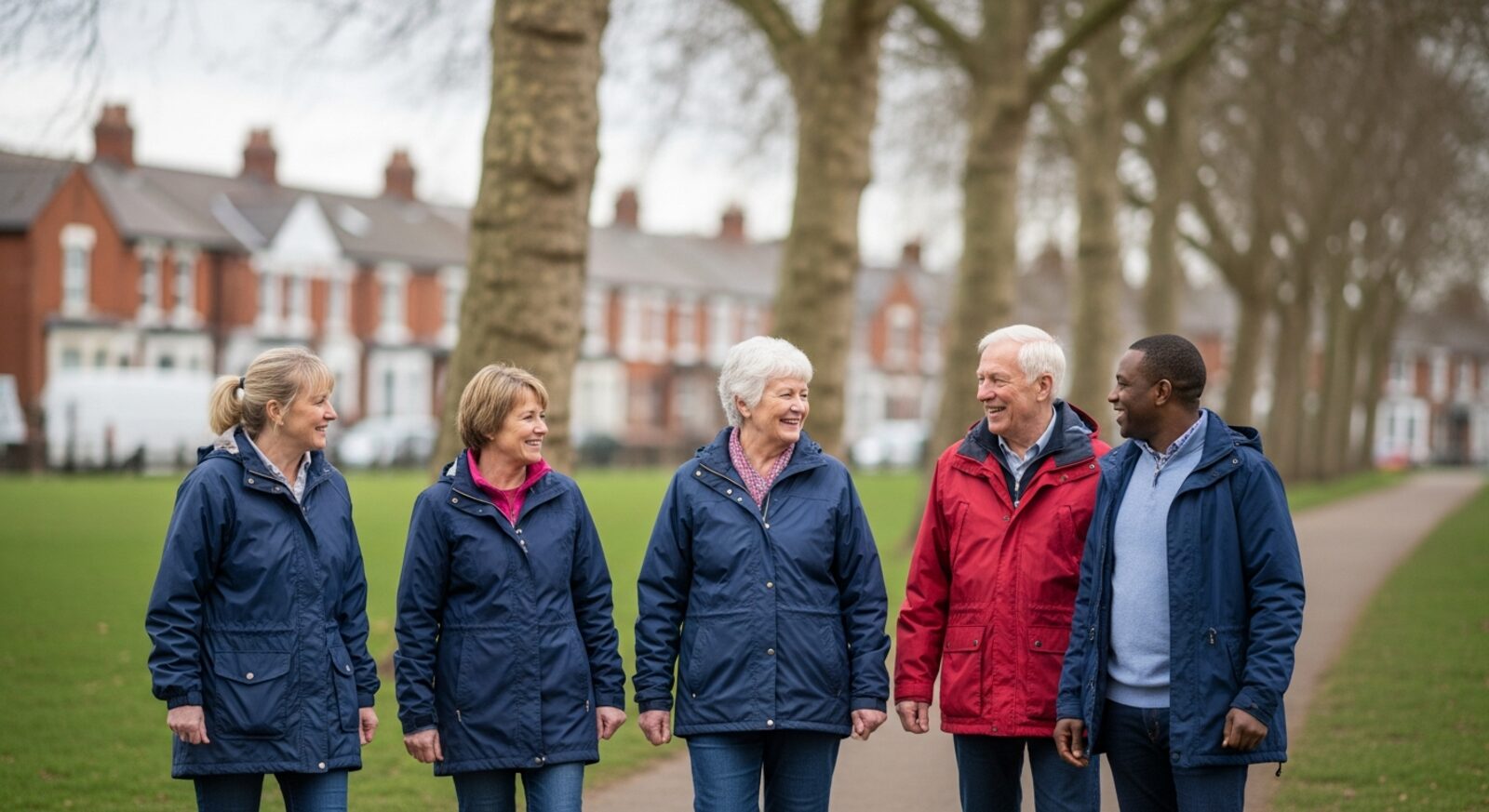
A community walking group chatting together in a UK park

Measured before and after community referral, read from the GP record: same patients, matched windows either side. Verified against the live platform, July 2026.

40% fewer GP contacts

from 17.5 to 10.5 per patient per year, high-dependency patients, twelve months each side

Source: Joy platform database, high-dependency patients, GP record before and after

63% fewer A&E attendances

from 1.61 to 0.60 per patient per year, same cohort

Source: Joy platform database, July 2026

55% fewer fit notes issued

from 0.90 to 0.40 per patient per year, same cohort

Source: Joy platform database, July 2026

Wellbeing up 13 points (ONS4)

16,806 paired journeys, 73% of people improved

Source: Joy platform database, July 2026

HbA1c back under the diabetes threshold

48.3 to 46.9 mmol/mol, 462 paired GP-record readings

Source: Joy platform database, July 2026

71% improved on PHQ-9 depression

cohort average 11.5 down to 7.7, 325 paired journeys; GAD-7 anxiety: 67% improved, 13.9 down to 9.7 (147 paired)

Source: Joy platform database, July 2026

25% fewer emergency hospital admissions

from 47 to 35 per 1,000 patients per year, n=80,330, GP and referral records combined

Source: Joy platform database, July 2026

These are before-and-after comparisons, based on our real experience of referring patients. The independent evidence base points the same way: 28% fewer GP consultations and 24% fewer A&E attendances where social prescribing is effective (University of Westminster).

Includes signposting activity. External corroboration: University of Westminster evidence review.

Approved by NHS

Joy connects people with local services easily, showcasing measurable outcomes.

1,903,000

Referrals and support cases

161,100

Professional sign-ups

83,100

Live community services

28,000

Machines running JoyConnect

Covering 22.5 million patients, with referral activity in 36 of England's 36 integrated care systems.

The whole system can refer in.

This is what good looks like in a mature neighbourhood health service, the sort of thing you can build to.

Self-referrals go straight into Warm homes and housing (illustrative routing; 10% of modelled flow overall)Self-referrals go straight into Purpose and role (illustrative routing; 10% of modelled flow overall)Self-referrals go straight into Work and vocational (illustrative routing; 10% of modelled flow overall)Informal carers go straight into Creative and nature on prescription (illustrative routing; 2% of modelled flow overall)Informal carers go straight into Health coaching and activation (illustrative routing; 2% of modelled flow overall)Informal carers go straight into Social connection (illustrative routing; 2% of modelled flow overall)Community pharmacy refer straight into Health coaching and activation (illustrative routing; 5% of modelled flow overall)Community pharmacy refer straight into Work and vocational (illustrative routing; 5% of modelled flow overall)Community pharmacy refer straight into Carer support (illustrative routing; 5% of modelled flow overall)Hospital and discharge refer straight into Movement, strength and balance (illustrative routing; 5% of modelled flow overall)Hospital and discharge refer straight into Social connection (illustrative routing; 5% of modelled flow overall)Hospital and discharge refer straight into Warm homes and housing (illustrative routing; 5% of modelled flow overall)Social care and councils refer straight into Work and vocational (illustrative routing; 4% of modelled flow overall)Social care and councils refer straight into Practical and financial (illustrative routing; 4% of modelled flow overall)Social care and councils refer straight into Creative and nature on prescription (illustrative routing; 4% of modelled flow overall)Community mental health refer straight into Social connection (illustrative routing; 3% of modelled flow overall)Community mental health refer straight into Carer support (illustrative routing; 3% of modelled flow overall)Community mental health refer straight into Purpose and role (illustrative routing; 3% of modelled flow overall)VCSE organisations refer straight into Practical and financial (illustrative routing; 3% of modelled flow overall)VCSE organisations refer straight into Warm homes and housing (illustrative routing; 3% of modelled flow overall)VCSE organisations refer straight into Health coaching and activation (illustrative routing; 3% of modelled flow overall)Employment and wider partners refer straight into Carer support (illustrative routing; 2% of modelled flow overall)Employment and wider partners refer straight into Creative and nature on prescription (illustrative routing; 2% of modelled flow overall)Employment and wider partners refer straight into Movement, strength and balance (illustrative routing; 2% of modelled flow overall)GP surgeries also refer straight into Health coaching and activation (illustrative routing)GP surgeries also refer straight into Work and vocational (illustrative routing)GP surgeries also refer straight into Carer support (illustrative routing)GP surgeries route via social prescribing link workers: part of their 51% modelled shareSocial prescribing into Health coaching and activation: 30% of modelled needSocial prescribing into Movement, strength and balance: 20% of modelled needSocial prescribing into Work and vocational: 10% of modelled needSocial prescribing into Social connection: 9% of modelled needSocial prescribing into Practical and financial: 9% of modelled needSocial prescribing into Carer support: 8% of modelled needSocial prescribing into Warm homes and housing: 7% of modelled needSocial prescribing into Creative and nature on prescription: 4% of modelled needSocial prescribing into Purpose and role: 3% of modelled needWho refersGP surgeries: 51% of modelled referral flowGP surgeries51%Community pharmacy: 5% of modelled referral flowCommunity pharmacy5%Hospital and discharge: 5% of modelled referral flowHospital and discharge5%Social care and councils: 4% of modelled referral flowSocial care and councils4%Community mental health: 3% of modelled referral flowCommunity mental health3%VCSE organisations: 3% of modelled referral flowVCSE organisations3%Employment and wider partners: 2% of modelled referral flowEmployment and wider partners2%Link workers and neighbourhood teams: originate 15% of the modelled target flow themselves through proactive case-finding, and GP surgeries route part of their 51% share through hereLink workers and neighbourhood teams15%Self-referrals: 10% of modelled referral flowSelf-referrals10%Informal carers: 2% of modelled referral flowInformal carers2%What people needHealth coaching and activation: 30% of modelled needHealth coaching and activation30%Movement, strength and balance: 20% of modelled needMovement, strength and balance20%Work and vocational: 10% of modelled needWork and vocational10%Social connection: 9% of modelled needSocial connection9%Practical and financial: 9% of modelled needPractical and financial9%Carer support: 8% of modelled needCarer support8%Warm homes and housing: 7% of modelled needWarm homes and housing7%Creative and nature on prescription: 4% of modelled needCreative and nature on prescr…4%Purpose and role: 3% of modelled needPurpose and role3%

Every referrer goes straight into support (thin dashed lanes, illustrative routing). GP surgeries also route people through the link workers and neighbourhood teams in the middle, who fan out across the need categories; self-referrals and informal carers sit underneath them. Pill percentages are the modelled target shares.

Source: Joy's view of what good looks like in a mature neighbourhood health service, anchored to the Neighbourhood Health Framework (March 2026), the 10 Year Health Plan and national need indicators, and checked against the neighbourhoods on Joy furthest ahead.

THE PLATFORM

One loop, four tools.

Joy covers the whole journey from first contact to measured outcome, and works alongside your population health analytics, records and case management.

User Check

JoyConnect

Refer from any system your team already uses, with the deepest integrations built for the GP Connect systems, SystmOne and EMIS. Three clicks from where the person presents.

Primary careCommunity servicesMental healthSocial careHospital discharge
Learn more
Visibility

JoyMarketplace

The live network. 83,100 community services listed and taking referrals, open to professionals and to self-referral.

Self-ReferralsCommunityVCSEIPS in primary careDrug & alcoholIPS-SMI
Learn more
Task Added

Joy Case Management

Caseloads, appointments and outcome capture for the neighbourhood and WorkWell teams doing the delivery, with DWP-compliant recording built in.

Social PrescribingPersonalised CareWorkWellTrailblazers / Youth Guarantee
Learn more
Insights

JoyInsights

The evidence engine. Demand, inequality and outcome analytics, every figure traceable to its source.

Referral flowsService provisionHealth outcomesGaps in provisionUtilisation reductionsDWP outcomes (WorkWell)DWP outcomes (Trailblazers / Youth Guarantee)
Learn more

Built for NHS data from day one.

NHS Approved. ISO 27001. Cyber Essentials Plus. NHS IM1. NHS Data Security and Protection Toolkit. Patient data is used to route people to support and to measure what changed for them, and for nothing else.


NHS Approved
ISO 27001 certified
Cyber Essentials Plus certified
NHS IM1 integration
NHS Data Security and Protection Toolkit

Our DPIA, sub-processor list, and full assurance documentation are in the Joy trust centre.

See what Joy could do in your area.

Talk to our team about your neighbourhood, your data and your priorities. Not ready for a call? Start with the evidence.

We use cookies to understand how visitors use this site and to improve it. Analytics only run if you accept. See our privacy notice for details.